

It’s almost back-to-school time, and boy, it can be hard to go from relaxing summer days to sitting and working again. However, you can make the transition easier by adding fun activities that are also educational, such as Elephant Toothpaste.
What?
You may be wondering how this activity can be educational. Keep on reading and find out.
Now, have your kids ever begged for a science experiment that’s exciting, easy, and a little messy? We found one that checks all those boxes, and it earned my daughter a Top 10 spot in our state 4-H Public Speaking Contest in 2020! Her topic was Elephant Toothpaste, and she loved it so much that I decided I wanted to share it with other families.
This is a great way to have a little fun, whether you’re getting back to school or just want to have some fun with the kids.
Science experiments like this do more than entertain. They spark curiosity, teach real concepts, and make learning a hands-on experience. So, next time you hear “I’m bored,” grab these simple ingredients and make Elephant Toothpaste with your kids!

How to Make Elephant Toothpaste
Despite its funny name, this is real science in action! When you mix a few everyday ingredients, you create a foamy eruption that looks like toothpaste big enough for an elephant.
It’s a favorite STEM activity for families because:
- You only need common household items
- It’s quick and easy (done in 10 minutes!)
- You can customize the colors for extra fun
And don’t worry, it’s safe for kids (with adult supervision).
The Ingredients to Make Elephant Toothpaste
- 1 cup Hydrogen Peroxide (found in the first aid section of your grocery store)
- 2 teaspoons or 1 packet of active dry yeast
- 3 tablespoons warm water (really warm)
- 2 plastic water bottles or any container with a small opening
- 1 teaspoon or a small squirt of dish soap
Equipment
- Tablespoon
- Teaspoon
- Measuring cup
- A small bowl
- Spoon
Optional Materials and Ingredients
- Food coloring
- Funnel
- Something to catch the mess from the bottles (I used a cookie sheet)
Safety First!
- Adult supervision is a must.
- Wear goggles and gloves if using stronger hydrogen peroxide (6% or higher).
- Protect your surfaces with a tray or towel.
- This foam is safe to touch but not edible.
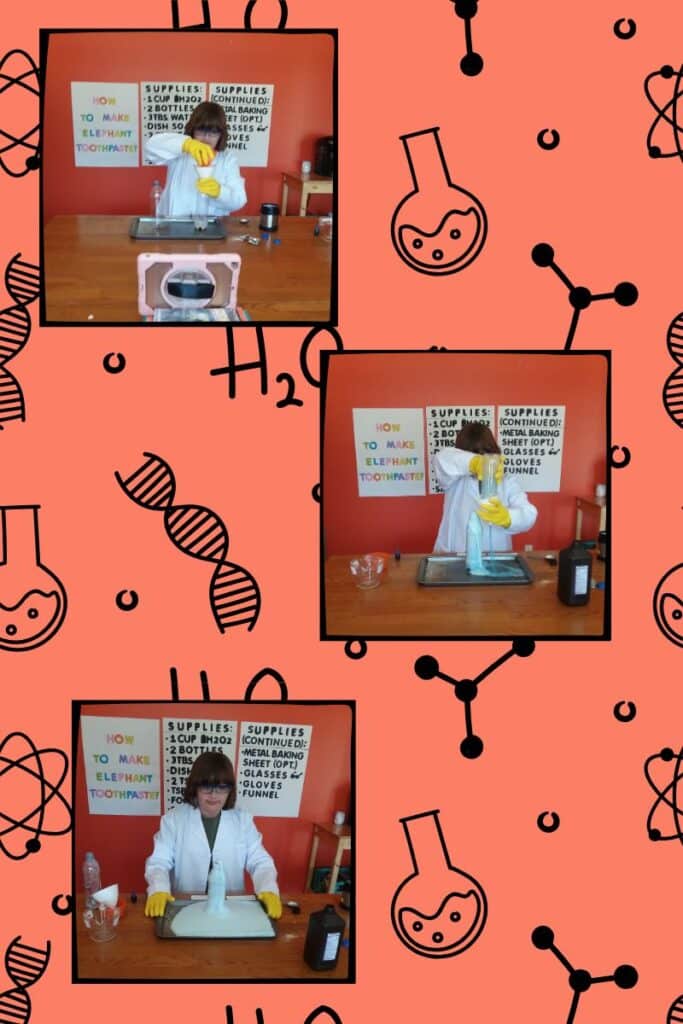
**Before we begin, it is worth noting that 3% hydrogen peroxide is effective. You will achieve the same results as my daughter did, as shown in the pictures below.
However, if you want very dramatic results, as seen in science shows, you will need higher concentrations of peroxide, such as 30%. You would need to search online to get this.
So, I recommend using a concentration higher than 3% hydrogen peroxide if you want larger eruptions.
Directions
- Activate the Yeast: In a small bowl, mix the warm water and yeast. Stir well and let it sit for a few minutes (around 5 minutes).
- Prep the Peroxide Bottle: Pour 1 cup of hydrogen peroxide into your main bottle. Add a squirt of dish soap and a few drops of food coloring for a colorful explosion!
- Combine & Watch the Magic: Carefully pour the yeast mixture into the peroxide bottle. This is where a funnel comes in handy. You’ll have less of a chance of spilling. Now
- Step back and enjoy the foamy eruption!
As a side note, I recommend adding food coloring. Otherwise, the “toothpaste” will be a dark tan.
The Science Behind Elephant Toothpaste
Now, this is a super fun experiment, but it is also educational!
Here’s what’s happening:
- Hydrogen Peroxide (H₂O₂) naturally breaks down into water and oxygen, but yeast acts as a catalyst, which means speeding up the process (just like yeast helps bread rise).
- When oxygen is released quickly, the soap traps the gas and creates tons of bubbles, which shoot out of the bottle like foam toothpaste!
- Here’s the extra cool part: this reaction is exothermic, meaning it releases heat as it occurs. If you touch the bottle after the reaction, you’ll notice it feels warm. That’s the energy from breaking chemical bonds being released as heat.
This is a fantastic way to introduce catalysts, chemical reactions, and exothermic reactions to kids in an engaging way.
{Download your own 1-page steps of this science experiment below.}

Turn Elephant Toothpaste Into a Learning Challenge
Ask your kids:
- What do you think will happen if you double the yeast?
- Which color makes the foam look coolest?
- What happens if you DON’T use warm water with the yeast?
Have them make predictions, observe, and record results for a mini science journal activity!
Then try the experiment again!
Safety Notes & Cleanup
The foam is just made from soap, water, and yeast, so it’s safe to touch, but don’t eat it. Cleanup is easy: just rinse it down the sink.
There you have it. Now you know the science behind Elephant Toothpaste. Your kids have learned a little chemistry in a fun and engaging way. Gather up your supplies and give it a try when the kids need something fun to do.
More Fun STEM Activities
If you are looking for other hands-on science activities to add some more Back-to-School fun, you might also like:
- Lego Balloon Cars: A Fantastic Way to Teach STEM
- STEM Zip Line Challenge
- STEM Boat Challenge Pack: Learn Buoyancy Through Building
Happy Homeschooling!